Entry #002 - The interaction between aerobic and anaerobic energy systems during endurance efforts

Hi Endurance Enthusiast,
We need to address a fundamental misconception in training architecture: the idea that your energy systems operate like light switches—flicking from "aerobic" to "anaerobic" the moment you cross a specific heart rate or pace.
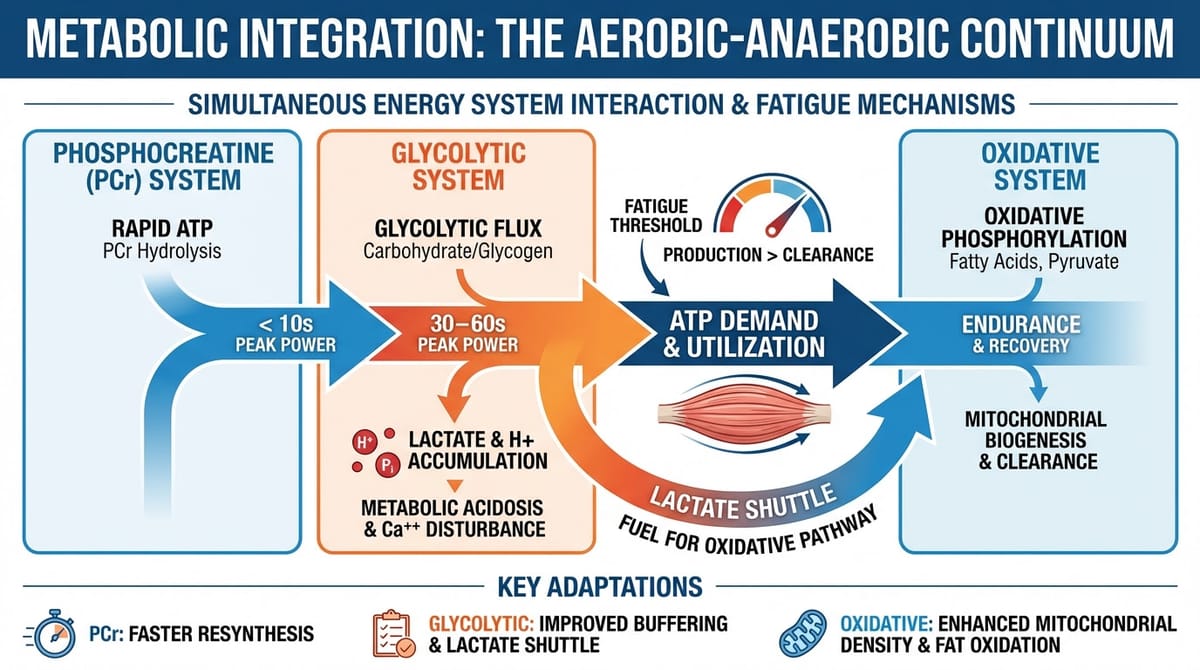
This sequential view of physiology is outdated and potentially detrimental to your programming. Biology does not deal in absolutes; it deals in flux. From the first pedal stroke or stride, your body is orchestrating a complex, simultaneous interaction between phosphocreatine hydrolysis, glycolytic flux, and oxidative phosphorylation. The question is not which system is working, but rather how they are interacting to meet the ATP demand, and more importantly, how the byproducts of one become the fuel for the other.
Today, we are deconstructing this metabolic handshake to help you build a more robust, fatigue-resistant engine.
Executive Summary
- Simultaneity over Sequentiality: All three energy systems (PCr, Glycolytic, Oxidative) contribute to energy production from the onset of exercise. The relative contribution shifts based on intensity and duration, but the "anaerobic" systems are never fully dormant, nor is the aerobic system ever solely responsible.
- Lactate is the Bridge, Not the Wall: Lactate is not a waste product causing fatigue; it is a critical fuel source and signaling molecule. The burning sensation is caused by hydrogen ion (H+) accumulation and inorganic phosphate, not lactate itself.
- Threshold as a Clearance Mechanism: The Lactate Threshold (LT) represents the intensity where production exceeds clearance. Improving performance requires training the aerobic system to "vacuum" up the lactate produced by the anaerobic system.
- Substrate Plasticity: Elite performance is characterized by "metabolic flexibility"—the ability to oxidize fat at high intensities (sparing glycogen) and the ability to rapidly switch to carbohydrates when demand spikes.
The Science at a Glance
Understanding the trade-offs between these systems is critical for designing interval protocols. Note that "Fatigue Mechanism" differs significantly across the spectrum.
| Energy System | Primary Substrate | Time to Peak Power | Physiological Limiting Factor | Key Training Adaptation |
|---|---|---|---|---|
| Phosphocreatine (ATP-PCr) | Creatine Phosphate | < 10 Seconds | PCr Depletion & Inorganic Phosphate accumulation | Increased PCr stores & faster resynthesis rates |
| Anaerobic Glycolysis | Muscle Glycogen / Glucose | 30–60 Seconds | Metabolic Acidosis (H+ accumulation), Ca++ cycling disturbance | Buffer capacity & Lactate Shuttle efficiency |
| Aerobic Oxidative | Fatty Acids & Pyruvate | 2–3 Minutes | Oxygen Delivery (Cardiac Output) & Mitochondrial Density | Mitochondrial biogenesis, Capillary density, Fat oxidation |
Foundational Principles
1. The Energy Continuum and the "Dimmer Switch"
Contrary to the old "switch" model, research confirms that energy provision is a continuum. During a maximal effort, the anaerobic glycolytic system provides rapid ATP, but it comes with a high "metabolic tax" in the form of hydrogen ions. The aerobic system works in the background, playing a critical role in recovery. Notably, approximately 80% of phosphocreatine (PCr) recovery occurs within one minute of rest, a process completely dependent on aerobic oxidative phosphorylation. This means your "anaerobic" sprint repeatability is actually dictated by your aerobic fitness.
2. The Uncoupling of Fatigue
We must separate the sensation of fatigue from the mechanism of fatigue. For decades, lactate was blamed for muscle failure. Contemporary data isolates inorganic phosphate (Pi) and hydrogen ions (H+) as the primary culprits.
- Pi Accumulation: As PCr is broken down, inorganic phosphate accumulates, directly inhibiting calcium release in the sarcoplasmic reticulum, which reduces contractile force.
- H+ Accumulation: Acidosis interferes with glycolytic enzymes.
The aerobic system’s job during high-intensity endurance efforts is to oxidize the lactate and buffer the H+. Therefore, a high VO2max is useful, but a high fractional utilization (Lactate Threshold) is what determines the pace you can sustain.
3. Metabolic Flexibility and the Crossover Point
The "Crossover Concept" dictates that as intensity increases, the body shifts from fat oxidation to carbohydrate oxidation. However, this crossover point is highly trainable. Untrained individuals may switch to dominant carbohydrate reliance at 50-60% of VO2max. Elite athletes, through high-volume low-intensity training, can push this crossover point to 75-80% of VO2max. This allows them to preserve limited glycogen stores for the decisive moments of a race.
Scientist’s Insight:
"Biological data is noisy. While we look for specific thresholds (like 4 mmol/L for lactate), individual physiology varies substantially. Day-to-day variability in Respiratory Exchange Ratio (RER) can be influenced by diet, sleep, and prior training status. Do not treat a lab value measured three months ago as an immutable law today."
The Decision Matrix
Use this diagnostic to identify which energy system interaction is your current "rate limiter" and how to adjust your training focus.
| Symptom / Observation | The Diagnosis | The Prescription |
|---|---|---|
| "I have high top-end power/speed, but I fade immediately after 2-3 minutes." | High Anaerobic Capacity / Low Aerobic Clearance. Your glycolytic system produces massive energy (and lactate), but your aerobic vacuum is too small to clear the byproduct. | Volume Focus. Prioritize Zone 2 (65-75% HRmax) to build mitochondrial density and lactate clearance transporters (MCT-1). |
| "I can go forever at a medium pace, but I cannot surge or change stuck." | The "Diesel" Engine. High efficiency, but poor glycolytic flux or neuromuscular recruitment. | VO2max Intervals. High-intensity bouts (e.g., 4 x 4min) to stimulate anaerobic power and maximum aerobic uptake simultaneously. |
| "My breathing is controlled, but my legs burn and lose power early in the event." | Peripheral Limitation. Your cardiovascular system (central) is delivering oxygen, but the muscles (peripheral) cannot utilize it or buffer the acidosis efficiently. | Threshold Training. Long intervals at 90-95% of FTP (Sweet Spot) to improve local muscular endurance and buffering capacity. |
The Protocol: Optimizing System Interaction
This protocol is designed to improve the Lactate Shuttle—the mechanism by which the body moves lactate from producing cells (fast-twitch) to consuming cells (slow-twitch/heart).
Frequency: 1x per week during Build Phase.
1. The Warm-Up (Metabolic Priming)
- 15 minutes easy ramping to 60% VO2max.
- 3 x 1-minute "Openers" at 100-110% FTP (Threshold Power).
- Purpose: Activate glycolytic enzymes and increase blood flow without inducing deep fatigue.
2. The Main Set: Over-Unders (Lactate Clearance)
- Concept: You will purposefully flood the muscle with lactate ("Over"), then force the muscle to process that lactate as fuel while maintaining a high work rate ("Under").
- Execution: 3 sets of 10 minutes continuous riding/running.
- The Structure:
- 2 minutes at 105-110% of Lactate Threshold (The Flood).
- 2 minutes at 90% of Lactate Threshold (The Clearance).
- Repeat 2.5 times (ending on an "Under").
- Recovery: 5 minutes extremely easy between sets.
3. Nutritional Context
Perform this session with high carbohydrate availability (consume 30-60g carbs/hour). High-intensity glycolytic flux requires exogenous glucose. Attempting this "fasted" will result in a failure to reach the required intensity to stimulate adaptation.
4. The Cool Down
15 minutes at <55% VO2max to facilitate the oxidation of remaining systemic lactate.
Case Study: The Non-Linear Path of Athlete "J"
Subject: Male Cyclist, 35 years old.
Profile: High "Diesel" capability. Strong time trialist, poor repeated sprint ability.
The Problem: J's Functional Threshold Power (FTP) had plateaued at 280W for two seasons. He was exclusively performing "Sweet Spot" training (moderate-hard intensity). His body had maximized its ability to buffer acid at that specific intensity, but he lacked the "ceiling" to pull his threshold up.
The Intervention:
We implemented a Polarized approach.
- Reduced Moderate Intensity: We cut the "Sweet Spot" work to zero.
- Volume Injection: Increased low-intensity (Zone 1/2) volume by 20% to improve fat oxidation and mitochondrial efficiency.
- Ceiling Push: Added one session of High-Intensity Interval Training (HIIT) specifically targeting 120% of VO2max (30s on / 30s off).
The Outcome:
For the first 4 weeks, J felt "slow" and "flat," a common sensation when withdrawing from chronic glycolytic stress. However, in Week 8, J performed a field test.
- FTP: Increased to 295W (+15W).
- Repeatability: Could repeat 5-minute maximal efforts with only 5% power degradation (previously 12%).
The Science: By improving his aerobic "vacuum" (Zone 2) and raising his aerobic ceiling (HIIT), he created room for his Threshold to rise. The previous "middle zone" training was causing too much autonomic stress without sufficient specific signal for VO2max improvement.
Train smart,
Dr. Thomas Mortelmans
PS: I read every single note you send.Share your feedback with me here—it’s completely anonymous and takes less than a minute!
Annotated References
- Skeletal muscle energy metabolism during exercise
Summary: A comprehensive review detailing how muscle fibers regulate ATP turnover and the simultaneous integration of carbohydrate and lipid oxidation during varying intensities. - Using Lactate Threshold Data
Summary: This NSCA guide explains why lactate threshold is a superior predictor of endurance performance compared to VO2max and how to practically apply threshold data to training zones. - Anaerobic Threshold: Its Concept and Role in Endurance Sport
Summary: A deep dive into the physiological mechanisms of the anaerobic threshold, highlighting the distinct roles of the ventilatory and lactate thresholds in performance monitoring. - The multiple roles of phosphate in muscle fatigue
Summary: This paper challenges the lactate-fatigue hypothesis, identifying inorganic phosphate accumulation and calcium precipitation as primary causes of muscle force failure. - Increased substrate oxidation and mitochondrial uncoupling in muscle of endurance-trained individuals
Summary: Research demonstrating that endurance training increases mitochondrial volume and oxidative capacity, leading to greater efficiency in submaximal substrate utilization. - A comparison of substrate utilization profiles during maximal and submaximal exercise
Summary: An analysis of the "crossover point," showing how exercise intensity and individual body composition dictate the shift from fat to carbohydrate oxidation.
Disclaimer: The content provided in this newsletter is for informational purposes only and does not constitute medical advice, diagnosis, or treatment. Always seek the advice of your physician or other qualified health provider with any questions you may have regarding a medical condition. Reliance on any information provided by The Scientist’s Notebook is solely at your own risk.