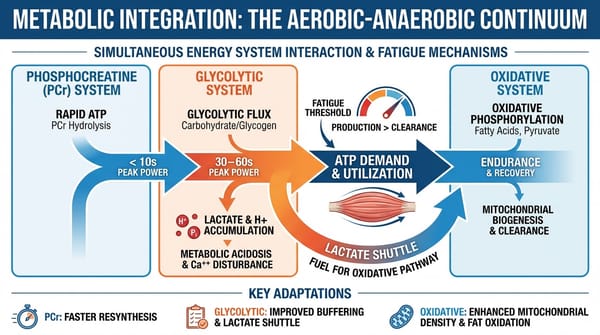
OpenLab #001: Real-time muscle oxygen measurements correlate well with blood lactate - Dr. Phil Batterson

Hi Endurance Enthusiast,
Happy Friday!
In this special ´Open Lab´ edition, we explore the localized environment where performance ultimately succeeds or fails: the working muscle. To guide us in this endeavor, we’re excited to share that today’s content was co-authored with Dr. Phil Batterson, a pioneer in muscle oxygen sensing and its application in endurance sport.

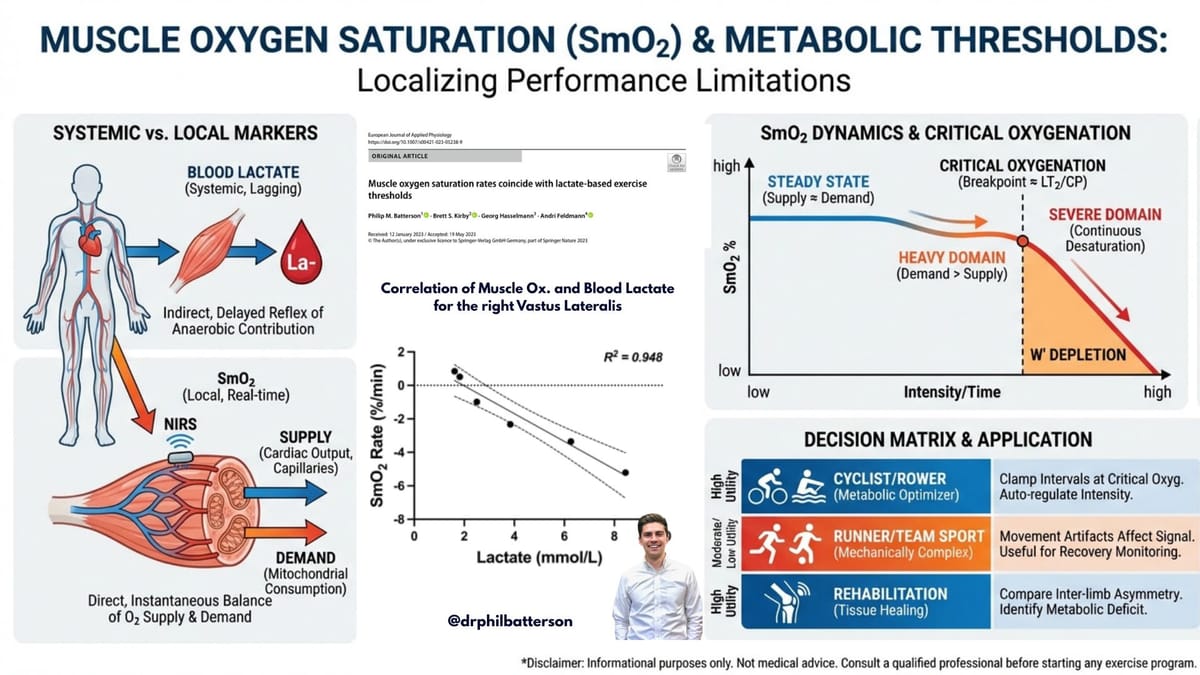
For decades, we have relied on blood lactate—a systemic marker—to infer the metabolic state of local tissue. While gold-standard, this method is invasive, discontinuous, and subject to clearance rates that can mask real-time production. The emergence of portable Near-Infrared Spectroscopy (NIRS) allows us to measure Muscle Oxygen Saturation (SmO2) non-invasively. The question facing the modern physiologist is not if the technology works, but whether the data it produces is a valid surrogate for the metabolic thresholds we currently use to construct training architecture.
Executive Summary
- Correlation with Lactate: The rate of change in SmO2 (SmO2 slope) demonstrates a strong negative correlation (r > 0.90) with blood lactate concentrations during incremental exercise.
- Threshold Concordance: NIRS-derived breakpoints align reliably with the Second Lactate Threshold (LT2) or Critical Power, marking the boundary between heavy and severe intensity domains. However, agreement at the First Lactate Threshold (LT1) is weaker and prone to underestimation.
- Mechanism of Action: SmO₂ provides a rapid, local proxy for the balance between oxygen delivery and extraction. A negative slope indicates demand exceeding supply.
- Operational Constraints: Data quality is highly sensitive to adipose tissue thickness (signal attenuation) and movement artifacts, making the technology more robust in cycling and rowing than in running.
The Science at a Glance
The following table contrasts the physiological signals provided by systemic blood lactate sampling versus local NIRS monitoring.
| Feature | Blood Lactate (La-) | Muscle Oxygen (SmO2) |
|---|---|---|
| Physiological Source | Systemic circulation (Production minus Clearance) | Local capillary-to-mitochondria gradient |
| Temporal Dynamics | Delayed (Lag time for efflux into blood) | Instantaneous (Real-time metabolic shift) |
| Threshold Alignment | The Gold Standard definition for LT1/LT2 | Good agreement at LT2; poor/variable at LT1 |
| Invasiveness | High (Requires lancet/blood draw) | Zero (Optical sensor) |
| Sensitivity | Affected by diet, hydration, and prior buffering | Affected by probe placement and adipose depth |
| Physiological Strain Indicator* | Indirect measure (via anaerobic glycolysis byproduct) | Direct measure (Oxygen supply/demand mismatch) |
*In the end, overall fatigue is multi-factorial (fatigue is multifactorial: neural, metabolite accumulation, muscle damage, etc.)
Foundational Principles
1. The Supply-Demand Divergence
The fundamental utility of NIRS lies in its ability to quantify the balance between oxygen delivery and extraction. At low intensities, increases in blood flow match metabolic demand, resulting in a flat or slightly positive SmO2 slope. As intensity increases, mitochondrial oxygen consumption outpaces delivery.
Scientist’s Insight: "SmO₂ kinetics provide a window into the transition from steady-state to non-steady-state metabolism. When oxygen extraction increases faster than delivery, muscle oxygenation declines progressively rather than stabilizing. This behavior is characteristic of intensities at which local oxidative capacity can no longer fully support ATP demand, a transition that often parallels the systemic accumulation of blood lactate."
2. The "Desaturation" Breakpoint
Research indicates that SmO2 does not decline linearly. It exhibits distinct deflection points. The most reliable of these occurs when the muscle transitions from heavy to severe intensity (approximating Critical Power). Above this intensity, a steady state of oxygenation is impossible; the muscle will continuously desaturate until failure or until the reserve capacity (W') is depleted. This "Critical Oxygenation" point provides a real-time ceiling for sustainable performance that reacts faster to terrain changes than heart rate.
3. The Heterogeneity of Extraction
Unlike heart rate, which is a global integer, SmO2 is site-specific. It is common to observe different desaturation kinetics in the vastus lateralis versus the rectus femoris during cycling. This variability is not "noise" but rather data regarding recruitment patterns and local fatigue. However, practitioners must be intellectually honest about the limitations: skinfold thickness attenuates the NIRS signal. If the light cannot penetrate the adipose layer to reach the myoglobin, the data reflects non-contractile tissue rather than metabolic status.
The Decision Matrix
Use this matrix to determine if NIRS/SmO2 integration is appropriate for your current training phase and athlete profile.
Category 1: The Metabolic Optimizer
- Profile: Cyclist, Rower, or Triathlete targeting specific physiological adaptations (e.g., raising LT2).
- Utility: High.
- Application: Use SmO2 to clamp intervals at the exact limit of oxygen supply-demand equilibrium (Critical Oxygenation) rather than relying on power, which may vary daily based on fatigue.
Category 2: The Mechanically Complex
- Profile: Runner or Team Sport Athlete involving high impact/oscillation.
- Utility: Moderate to Low.
- Application: Movement artifacts during running can distort the optical signal. While useful for interval recovery (resaturation) monitoring, identifying precise thresholds during running is less reliable than in stationary sports due to sensor movement.
Category 3: The Rehabilitation Candidate
- Profile: Athlete returning from soft tissue injury or ACL reconstruction.
- Utility: High.
- Application: Compare SmO2 desaturation rates between the injured and uninjured limb. Asymmetry in oxygen extraction may persists even after strength symmetry is restored, indicating a metabolic deficit in the healing tissue.
The Protocol: Establishing Critical Oxygenation
If you possess a NIRS device, do not rely on the "zones" provided by default apps. Use this field test to determine your specific metabolic breakpoints.
Step 1: Preparation and Placement
Place the sensor on the primary prime mover (e.g., Vastus Lateralis for cycling). Ensure consistent placement (measure cm from patella) to ensure longitudinal reliability. Secure with blackout tape to prevent ambient light interference.
Step 2: The 5-1-5 Assessment
Perform a graded exercise test.
- Warm-up: 15 minutes very easy.
- Steps: Increase intensity by a fixed wattage (e.g., 20W or 30W) or speed every 3 minutes (Note: 3-5 minute steps allow for signal stabilization better than 1-minute ramps).
- Rest: Include a 1-minute rest interval between each step. This allows you to view "resaturation" kinetics.
Step 3: Data Analysis
- Identify the Plateau: Look for the intensity where SmO2 stops dropping initially and stabilizes (often near LT1).
- Identify the Drop (The Breakpoint): Locate the intensity where SmO2 begins a precipitous, non-linear decline that does not stabilize. This breakpoint typically correlates with LT2/Critical Power.
- Assess Recovery: Observe the resaturation slope during the 1-minute rest. A failure to resaturate to baseline between intervals indicates you have crossed the metabolic threshold.
Step 4: Training Application
For "Threshold" intervals, target the SmO2 % associated with your Breakpoint. If your SmO2 drops 5% below this target during an interval, reduce power. You are effectively clamping the internal metabolic load rather than external power.
Case Study: Non-Linear Progress in a Master’s Cyclist
Subject: "Mark," a 45-year-old hypthetical competitive cyclist.
Presenting Problem: Plateaued Functional Threshold Power (FTP) despite increased high-intensity interval volume.
Hypothesis: Mark is failing to recover adequately between bouts, shifting training stress from aerobic development to autonomic strain.
The Intervention:
- Week 1 Data: Mark performed intervals at 300W. SmO2 dropped to 45% and continued to slope downward (-0.5% per minute) throughout the interval. During rest periods, SmO2 only recovered to 60% (baseline 75%).
- Analysis: The negative slope indicated he was operating above Critical Power (severe domain), not at it.
The Adjustment:
- We stopped prescribing watts and prescribed an SmO2 "Floor" of 50%. Mark had to adjust power to keep oxygenation flat.
- Result: His power dropped to 285W initially. However, he was able to complete the total volume with stable oxygenation.
- Outcome (8 Weeks): By training the oxidative flux capacity rather than forcing anaerobic power, Mark’s power at the 50% SmO2 floor rose to 310W. The plateau was broken not by pushing harder, but by respecting the biological limit of oxygen delivery.
Note: This case does not imply that SmO₂ replaces power, lactate, or established threshold models. Rather, it illustrates how local oxygenation metrics can be used to regulate internal load, helping athletes avoid accumulating excessive non-productive strain while still driving meaningful aerobic adaptation.
Best regards,
Dr. Thomas Mortelmans & Dr. Phil Batterson
Annotated References
- Using Lactate Threshold Data Summary: This study establishes that the rate of muscle oxygen desaturation correlates strongly (r > 0.90) with blood lactate concentration, validating NIRS as a non-invasive proxy for metabolic threshold detection in elite athletes.
- NIRS in Sports Science Summary: An overview of the physics behind Near-Infrared Spectroscopy, explaining how modified Beer-Lambert laws allow for the differentiation of oxyhemoglobin and deoxyhemoglobin in skeletal muscle.
- Physiological Systems in Rowing Summary: This investigation into female rowers demonstrates that while SmO2 breakpoints align well with the second lactate threshold (LT2), they frequently underestimate the first threshold (LT1), suggesting caution when using NIRS for low-intensity zone prescription.
- Limitations of NIRS Summary: A critical analysis highlighting that adipose tissue thickness acts as a confounding variable, significantly attenuating signal quality and complicating threshold identification in athletes with higher body fat percentages.
- Critical Power and SmO2 Summary: This research identifies "Critical Oxygenation"—the point where SmO2 slope breaks toward continuous desaturation—as a physiological mirror to Critical Power, defining the boundary of sustainable exercise.
- Daily Application of SmO2 Summary: A practical guide on using real-time SmO2 data to auto-regulate training intensity, ensuring athletes remain in the heavy intensity domain without drifting into the severe domain due to daily fatigue variability.
- Trail Running and SmO2 Summary: Field research showing that SmO2 reacts faster to changes in gradient and terrain than heart rate, making it a superior metric for intensity control during variable-terrain running.
- Resaturation Kinetics Summary: A longitudinal study suggesting that the rate of muscle re-oxygenation (resaturation) during rest intervals may improve with training, serving as a potential marker for mitochondrial adaptation over a season.
- Intermittent Sports Application Summary: This paper explores NIRS in rugby and field hockey, noting that while sprint-induced desaturation is consistent, individual recovery kinetics vary widely and correlate with repeated-sprint ability.
- Reliability of SmO2 Summary: An examination of test-retest reliability indicating that while SmO2 is reliable at moderate intensities, signal noise increases significantly at maximal effort, necessitating standardized probe placement.
- Protocol Dependency Summary: This methodological review emphasizes that the duration of step stages in graded exercise tests significantly alters SmO2 kinetics, arguing that longer steps are required for valid threshold determination.
- Oxygen Supply-Demand Matching Summary: A deep dive into the mechanistic link between muscle oxygenation and metabolic stability, proposing that SmO2 dynamics provide a window into the finite work capacity (W') depletion above Critical Power.
- Comparison of Threshold Methods Summary: A meta-analysis confirming that NIRS-derived thresholds are most reliable for detecting the anaerobic threshold (LT2) but should be used as a complement to, rather than a full replacement for, blood lactate testing.
- Training Zone Prescription Summary: This study validates the use of SmO2 breakpoints to establish training zones, demonstrating that biofeedback from NIRS can help athletes avoid "zone drift" during endurance sessions.
- Oxidative Capacity Assessment Summary: Research demonstrating that skeletal muscle oxidative capacity, measured via NIRS recovery kinetics after occlusion, correlates significantly with VO2max, linking local tissue function to whole-body aerobic power.
Disclaimer: The content provided in this newsletter is for informational and educational purposes only and does not constitute medical advice, diagnosis, or treatment. The physiological mechanisms and training protocols discussed may not be suitable for all individuals. Always seek the advice of a physician or other qualified health provider with any questions you may have regarding a medical condition or before beginning any new exercise program. The author and publisher disclaim liability for any adverse effects resulting from the use or application of the information contained herein.